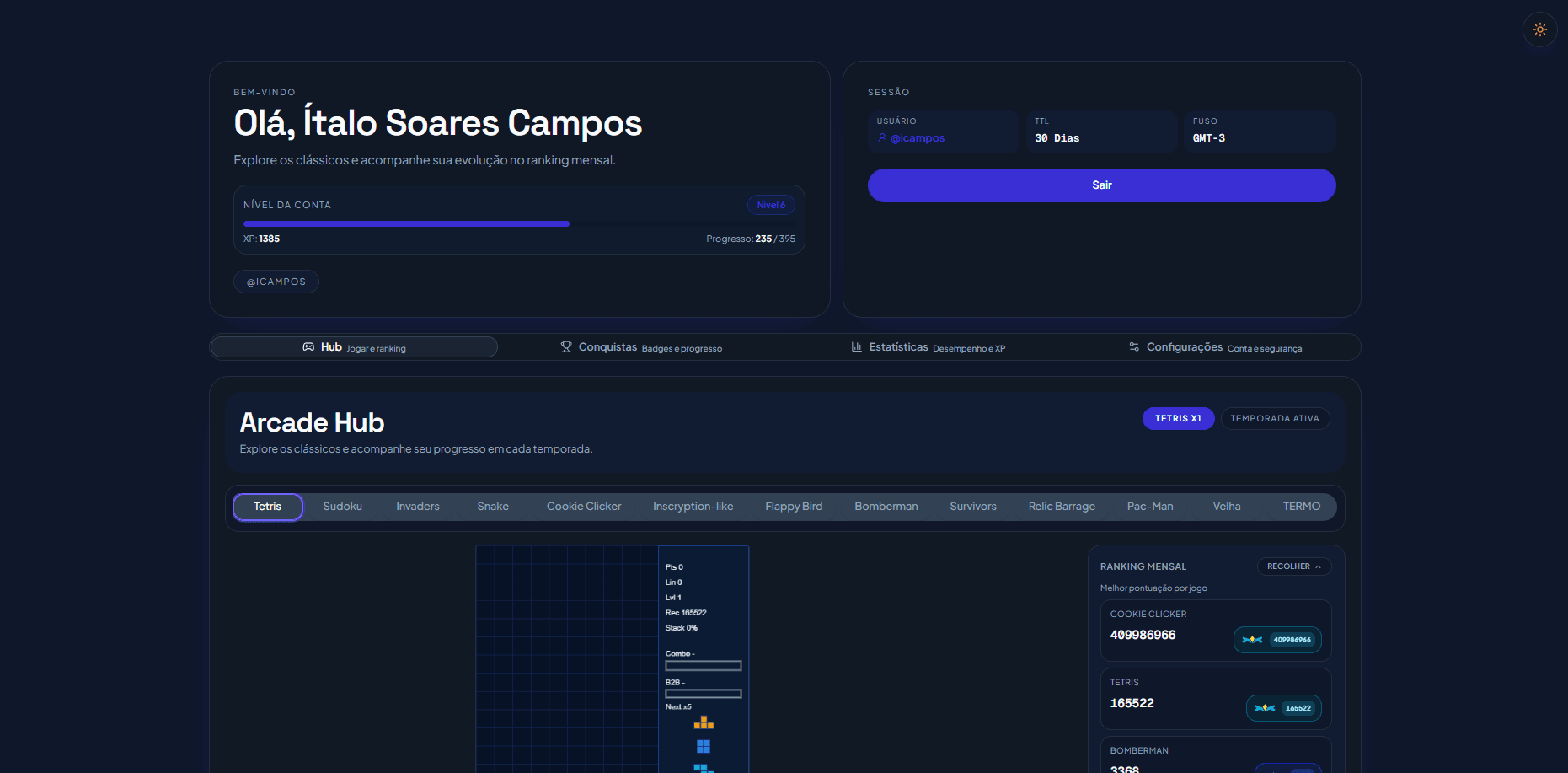
ITL Game Hub is a personal experimental platform designed to explore game architecture and interactive systems within a modern web stack.
The project combines a traditional web application layer (authentication, profiles, and rankings) with gameplay-focused modules implemented in TypeScript. Games run on a deterministic client-side engine that exposes a render snapshot consumed by different renderers.
The platform currently mixes a custom Canvas renderer with an experimental Phaser runtime, allowing gameplay systems to remain independent from the rendering layer.
One of the main experiments inside the hub is Dungeon Gunners, a roguelite top-down shooter featuring procedural map structures, room-based progression, weapon systems, and early cooperative multiplayer mechanics built around an event-driven protocol.
Beyond gameplay, the project also explores AI-assisted development workflows, specification-driven implementation, and maintainable code organization for complex interactive systems.
Problem
The main challenge was designing a platform capable of hosting multiple games with different mechanics while preserving a clean architecture and consistent user experience.
The platform needed to support authentication, persistent rankings, and game-specific progression while still allowing each game to evolve independently.
At the gameplay level, the system also had to maintain smooth frame updates and responsive interactions, even when experimenting with different rendering approaches and gameplay mechanics.
Architecture
The architecture separates platform concerns from gameplay systems.
The application layer is built with Next.js App Router and manages authentication, profiles, ranking systems, and navigation between games.
Gameplay systems are implemented in a deterministic client-side engine written in TypeScript. The engine advances the game state through a step(delta, input) loop and exposes a snapshot that represents the current render state.
Renderers consume this snapshot without owning gameplay logic. This makes it possible to experiment with multiple rendering implementations, including a custom Canvas renderer and a Phaser-based runtime.
The codebase is organized into clear domains across app, components, and shared modules, allowing gameplay features to evolve without tightly coupling them to the UI layer.
Implementation
The platform currently hosts multiple experimental games and prototypes.
The most advanced project inside the hub is Dungeon Gunners, a roguelite shooter inspired by games like Soul Knight. It features procedural room progression, enemy spawning systems, weapon mechanics, armor and health layers, and room transition rewards.
Additional systems include minimap rendering, HUD layers, combat feedback loops, and event-driven multiplayer prototypes for cooperative sessions.
The implementation also explores AI-assisted development workflows through specification-driven features and structured project context, allowing faster iteration on complex gameplay ideas.
Impact
The project became a personal sandbox for experimenting with gameplay architecture, rendering pipelines, and interactive system design.
By separating gameplay logic from rendering and platform layers, the project maintains flexibility for new experiments without requiring major rewrites.
Beyond gameplay features, the project also helped explore workflows combining structured specifications with AI-assisted implementation, accelerating experimentation while preserving architectural control.