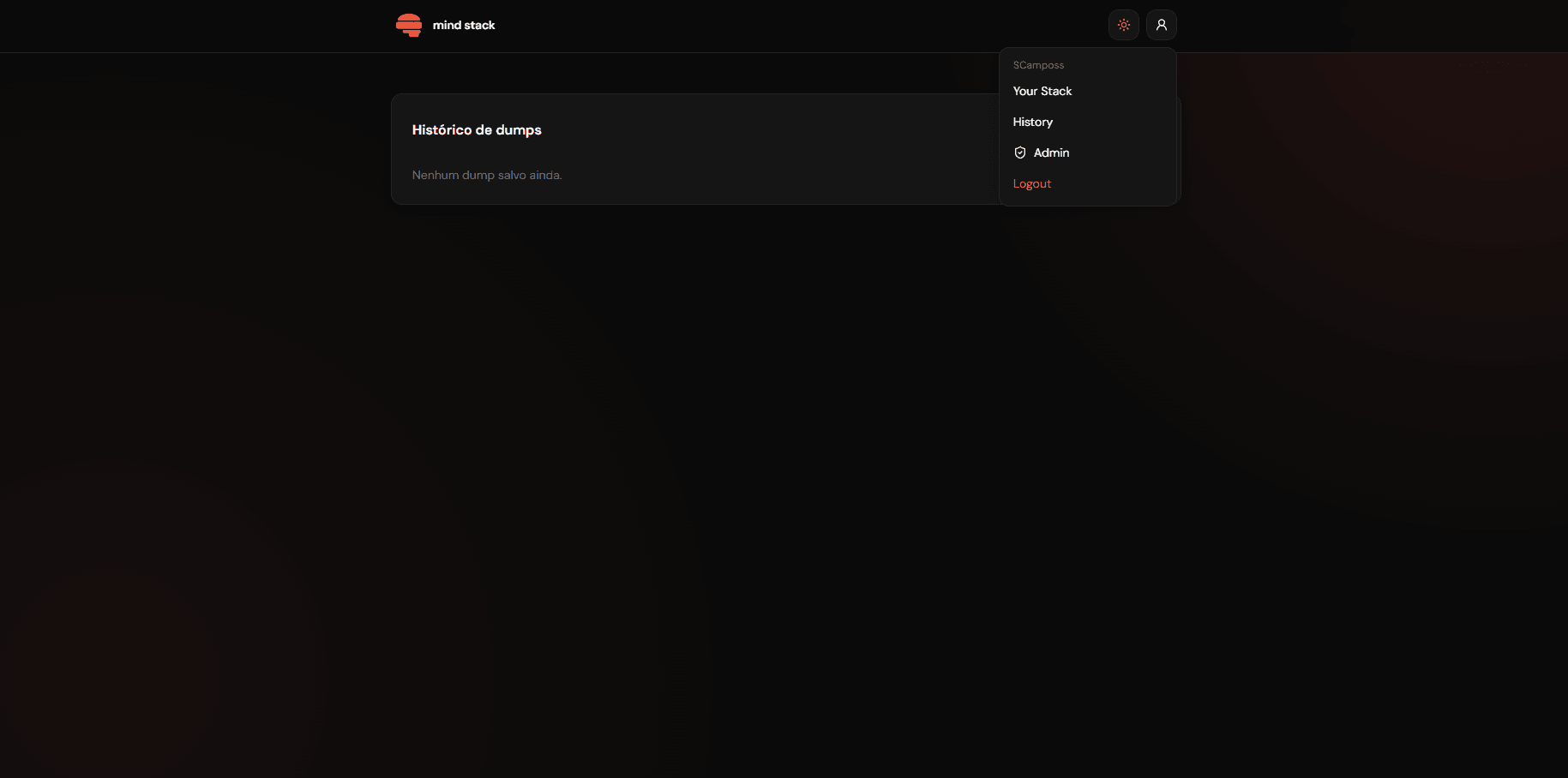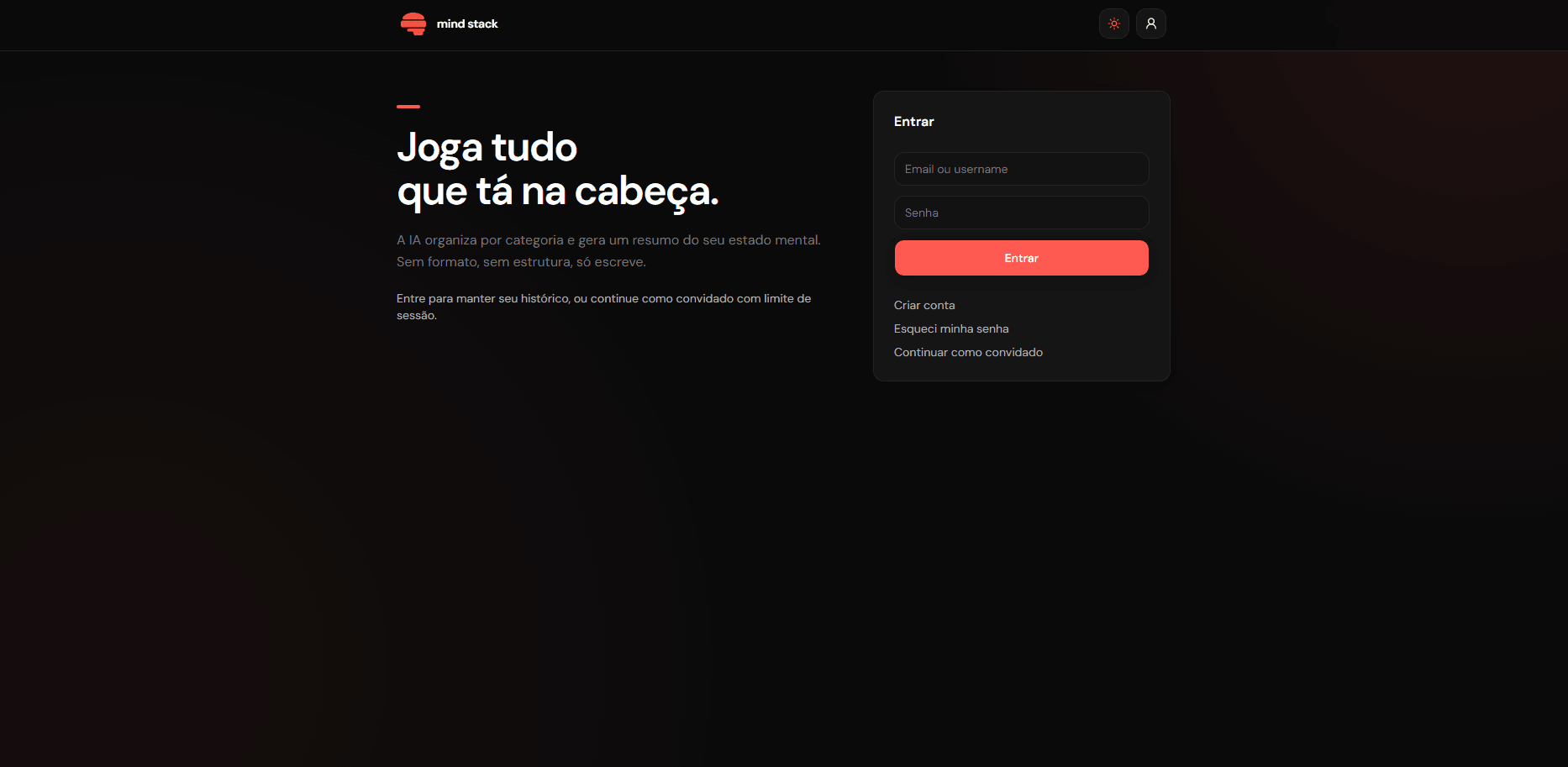
Mind Stack is a full-stack AI application designed to transform unstructured thoughts into organized insights.
The application allows users to perform a free-form "brain dump" which is analyzed by an AI pipeline that extracts individual thoughts, categorizes them, and generates a concise summary of the user's mental state.
Beyond the core AI workflow, the project focuses on production-oriented architecture and product engineering principles. It includes authentication with guest and registered users, quota-based usage limits, role-based access control, persistent storage, and an admin panel for managing users and permissions.
The system is structured using a layered architecture that separates UI, domain logic, infrastructure services, and persistence. API routes delegate to server-side use cases, enabling better testability, maintainability, and scalability.
Mind Stack demonstrates modern AI-assisted development practices while maintaining strong engineering discipline in system design, validation, testing, and data modeling.
Problem
Many productivity tools require users to structure their thoughts before writing, which can create friction when someone simply wants to unload everything on their mind.
Mind Stack addresses this by allowing users to perform a completely unstructured brain dump. The system then uses AI to extract individual thoughts, classify them into meaningful categories, and generate a concise summary of the user's mental state.
The goal was to design a system that reduces cognitive friction while still producing structured and actionable information.
Architecture
Mind Stack follows a layered full-stack architecture built with Next.js App Router.
The UI layer focuses purely on presentation and interaction. API routes act as transport adapters that delegate execution to server-side use cases. Domain services encapsulate the AI analysis workflow and business rules, while persistence is handled through Drizzle ORM with Neon Postgres.
This separation of responsibilities allows the system to remain maintainable and testable as features evolve.
Additional architectural concerns addressed include:
- role-based access control (guest, user, admin)
- quota enforcement before AI processing
- strict AI output validation with Zod
- dependency-injectable API handlers for testability
- migration-driven schema evolution
Implementation
The application implements a full AI processing pipeline combined with production-oriented platform features.
Users can create brain dumps which are analyzed by an AI service that extracts structured thoughts and summaries. Results are persisted and associated with user accounts or guest sessions.
The platform includes authentication, guest usage, quota-based access control, and a role system that enables administrative management.
Key features include:
- AI thought extraction and categorization
- role-aware authentication and session handling
- guest usage with limited quota
- persistent dump storage and history
- dump CRUD operations including “Forget” and “Clear your mind”
- admin panel for user management
- statistics and activity insights
- structured Markdown export for knowledge tools
Impact
Mind Stack demonstrates how AI-assisted development can accelerate product creation while maintaining strong engineering practices.
The project emphasizes clean architecture, reliable data validation, and modular system design rather than prototype-level shortcuts.
By combining AI processing with role-based access, persistence, and administrative controls, the application evolves beyond a simple demo into a realistic product-style system.
The result is a maintainable full-stack platform that can be expanded with additional features such as subscription tiers, analytics, or integrations without requiring fundamental architectural changes.